Simple expressions like that can cause serious trouble. That's what I found out in our history lessons on Monday and Friday. History is not my favourite subject and although I can't speek for my classmates I think we all started with a bit of scepticism into that course. But our teacher Jørn Buch was commited and highly motivated which was - especially on Friday morning - essential to keep us at it. In the course of time the lessons developed a certain self-dynamics and the more we were told about Danish history the more interested I got. Maybe it's needless to say that I especially enjoined the episode about the German-Danish borderline history and the stories behind it but for the first time I really immerged into my homeland history that deep. After talking about Danish history in general Jørn was very ambitious to give us a detailed insight into the vivid history of this region. One of his main points was the problem of harmonising national identities with historical borderlines. This challenge often causes serious problems ending up in war and hate all over the world (e.g. Israel, Kosovo,...). The history of borderlines between Germnay and Denmark has also been versatile during the last centuries.
Jørn's second interest was to show how history can be used to avoid conflicts and to prevent people to slip up like their ancestors. For me - born and grown up in a peaceful region - it was important to learn that even in my homeland Schleswig-Holstein times were not always like these.
that's me...
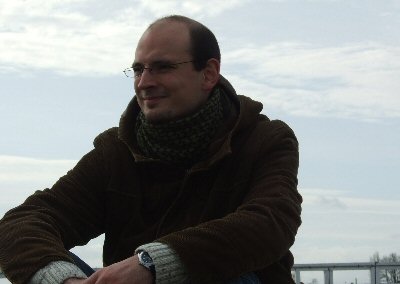
...just to give you a first impression of what I look like. I'll add some more pictures soon.
Saturday, February 23, 2008

Friday, February 22, 2008
Danish school life...
We started our third week on Monday with a recapitulation of our school visits during the first week. We collected the results of our observations and tried to make up generalized predications about the Danish school system. The keywords we listed were: freedom, feeling like at home, few rules, well equiped schools, many different ways to learn, little structure. Afterwards our teacher Torbjørn Ydegård tried to explain the reasons for certain aspects and provided us an insight into the Danish educational system. For example we talked about problematic pupils, the hidden curriculum and private schools. Torbjørn explained to us the importance of the work of Michel Foucault (e.g. "Discipline & Punish: The birth of the prison") for the Danish school system. "Michel Foucault is best known for his critical studies of various social intitutions, most notably psychiatry, medicine, the human sciences, and the prison system [which he related to the educational system], as well as for his work on the history of human sexuality. Foucault's work on power, and the relationships among power, knowledge, and discourse, has been widely discussed and applied." ( http://en.wikipedia.org/wiki/Michel_Foucault )
The second discussion topic was related to our observation of lacking structure in the lessons. We were introduced to the so called "hidden curriculum" which is quite important for Danish teachers. The focus is more on achieving learning strategies and competences than on data knowledge in the subjects. The idea was not new to me because I learned something similar in Germany. We call it "educational standards", "curriculum framework" or "key competences". What these concepts have in common is the increased importance of skills and competences in addition to knowledge in the subjects.
Torbjørn concluded our excursion to the Danish educational system with a short presentation about Danish private schools. The most striking aspect here was the possibility for parents to found a private school with - compared to our countries - little obligations. Another important point was the form of financing: Private schools get their benefits directly from the government whereas public schools are paid by the communities.
On Tuesday we continued our discussion about school systems with Torbjørn. He started off with presenting us two theoretical approaches concerning education: the interconnected didactical categories (ability, framework, aims and goals, content, methods, evaluation) are often refered to in the Danish educational system. The main focus is on the abilities the pupils should develop in school. It is often connected to Immanuel Kant ("All the preparations of reason, therefore, in what may be called pure philosophy, are in reality directed to those three problems only [God, the soul, and freedom]. However, these three elements in themselves still hold independent, proportional, objective weight individually. Moreover, in a collective relational context; namely, to know what ought to be done: if the will is free, if there is a God, and if there is a future world. As this concerns our actions with reference to the highest aims of life, we see that the ultimate intention of nature in her wise provision was really, in the constitution of our reason, directed to moral interests only."(Critique of pure reason, 1781)) and emphasizes the importance of using your reason.
This theory was also part of the approach by the German Wolfgang Klafki. Klafki furnished the term "Bildung" as related to autonomy (individual-related) and democracy / solidarity (society-related). In his approach the main focus in education is on the aims and goals.
The second theory by the Norwegian Erik J. Dale extracts the role of the teacher from the network of didactical categories. It focuses on the competences of teachers and classifies three categories: C1: the teacher standing in front of the class, C2: the teacher thinking about teaching / planing the lessons, C3: the teacher communicating about didactics / developing theories. According to Dale unfortunately most teachers remain stuck in the first two categories. He assumes that teachers lose their autonomy without participating in C3. Furthermore he advises against the potential danger of centralized top to bottom regulations of schools by the government.
The remaining time we prepared our next school excursion in pairs. I worked together with Charlotte and we decided to split up our observation interests into pupil's and teacher's actions and behaviour.
In conclusion I would say that I learned a lot about the differences in the educational systems of Denmark and Germany (or at least Schleswig-Holstein). Especially I appreciated the reference to Klafki whose approaches are often refered to in my home university. Thus I could recapitulate my knowledge and add new aspects about educational theories.
Tuesday, February 19, 2008
meet the mermaid...
We spent three days in Copenhagen, actually not enough time to see all sights and visit all places of interest. But we tried to see as much as possible walking around all day long. It would be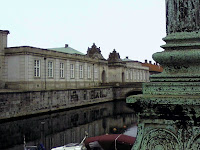 impossible for me to note down all my impressions and sensations without writing for the rest of the day. So to keep it short and clear I will just list the places and sights we (I) have been to and expand this list with a few keywords about feelings and impressions. It's just a short overview.
Main station: awing, wooden arch, capacious
Tourist information: informative, enlightening
Hostel: poky rooms, clean bathroom, nice bar
"Black diamond": extraterrestrial,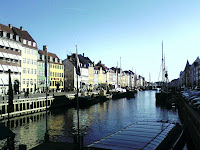 architectural blending, interesting
Nyhavn: retro chic, cozy quarter, gaudy
Christiansborg: being renovated, pallid, unspectacular
National museum: sizable, for free, diversified
Opera: spacy, large, modern
Kastellet: disappointing, dull
Little mermaid: photogenic, pleasant company, cute
National art museum: extravagant, trivial modern "art", impressive paintings
Rosenborg castle: dreamy, squiggled, romantic
RizRaz: satiating, delicious, varied
Town hall square: crowded, loud
Town hall: presentable, ample
University: phenomenal, richly adorned
St. Petri Kirke: closed, elegant appearance
Helligandskirken: colourful, plentyful ornated gallery
Vor Frue Kirke: detailed crafted statues, coolish
Marmorkirken: mind-blowing, amazing
Amalienborg: clean, organized, pretty
Christiania: alternatively, complementary world, twilight atmosphere
 impossible for me to note down all my impressions and sensations without writing for the rest of the day. So to keep it short and clear I will just list the places and sights we (I) have been to and expand this list with a few keywords about feelings and impressions. It's just a short overview.
Main station: awing, wooden arch, capacious
Tourist information: informative, enlightening
Hostel: poky rooms, clean bathroom, nice bar
"Black diamond": extraterrestrial,
 architectural blending, interesting
Nyhavn: retro chic, cozy quarter, gaudy
Christiansborg: being renovated, pallid, unspectacular
National museum: sizable, for free, diversified
Opera: spacy, large, modern
Kastellet: disappointing, dull
Little mermaid: photogenic, pleasant company, cute
National art museum: extravagant, trivial modern "art", impressive paintings
Rosenborg castle: dreamy, squiggled, romantic
RizRaz: satiating, delicious, varied

Town hall square: crowded, loud
Town hall: presentable, ample
University: phenomenal, richly adorned
St. Petri Kirke: closed, elegant appearance
Helligandskirken: colourful, plentyful ornated gallery
Vor Frue Kirke: detailed crafted statues, coolish
Marmorkirken: mind-blowing, amazing
Amalienborg: clean, organized, pretty
Christiania: alternatively, complementary world, twilight atmosphere
every day usage...
On Monday we started off with learning some expressions for every day usage in Danish and counting from 1 to 20. Sheila wanted to take us to a small café in the pedestrian precinct and wanted us to order our food and drinks in Danish. It was a nice task to train our language competence in a real and not a constructed class room situation. Unfortunately the waiter noticed that I was not from Denmark and immediately started talking in English. But nevertheless it was an experience...
Sunday, February 10, 2008
"Democracy for $500, please"...
"Give a water-tight definition for citizenship!"
I guess for a candidate in a quiz this question would be impossible to answer. There is not one single unchallenged definition for "citizenship". It is an essentially contested concept but what different approaches have in common is that citizenship is more than just knowing about rights and duties. It is also about identity and feelings of belonging.
But why is that important for us? I think that was the question most of us had in mind when we went to the citizenship and globalisation course on Friday. The answers to that questions were not easy to find. I will just try to summarize at least some of the attempts to find a solution:
During the last 25 years the EU had to face huge waves of immigrants coming to the European countries. This in combination with a decreasing knowledge about democracy among young people lead to a widespread discourse about the topic. In some countries this academic discourse resulted in the change of educational curricula or in the development of new school subjects. Central aims were in all cases to arouse an interest in the students to deal with the topic of citizenship. In the first place democratic values should be protected and no longer be seen as perpetually given. Democracy is a fragile concept and it is put to the test these days by migration, individualization and globalization. It implies not only a passive (signing a document, possessing a passport, ...) but also an active (raise one's voice, take part in society) role. As future teachers it will be our task to continue that discourse.
the clock and the pendulum...
Wednesday was all about using body and voice in many different ways. Topics were body language, voice, singing, acting, painting. I thought it was great fun making up little presentations in groups or painting the atmosphere of two music tracks. Regardless I'm not that much into dancing I liked our little dance performance and I had a great time singing songs and canons. And by the way, I think we did a brilliant job suggesting a very mysterious atmosphere like taken from an Edgar Allen Poe tale...
the rest of Tuesday...
Our first Danish lesson with Sheila and Lejf was more a repitition for me than learning new things for I attended a crash course in Danish before coming here. One little funny story was that the copies we were given are from the same book we used during the crash course in Germany. But nevertheless there was at least one thing I learned in the two hours: the pronunciation of Danish words is difficult for all of us, but it might be more difficult for people with one linguistic background than for those with another. I will keep an eye on that... ;-)
 In the afternoon we met with other European students to discuss the topic: "Language and identity". We had to colour an empty template and produce a so called language portrait. The colours were symbolizing laguages that are important for us. The underlying idea of the task was the integration of the aesthetic dimension into the cognitive learning process. I was very sceptical at the beginning because I associated the task with some kind of a kindergarten atmosphere. But in the course of the discussion it became clear that colours can be used as a possibility to transmit feelings (for example about languages). We also had to make up an "elfchen",
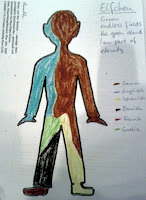 a poem consisting of eleven words, about one of the colours we chose. In the end I was pretty satisfied with the results of our discussions and our creative working periods. What do you think???
 In the afternoon we met with other European students to discuss the topic: "Language and identity". We had to colour an empty template and produce a so called language portrait. The colours were symbolizing laguages that are important for us. The underlying idea of the task was the integration of the aesthetic dimension into the cognitive learning process. I was very sceptical at the beginning because I associated the task with some kind of a kindergarten atmosphere. But in the course of the discussion it became clear that colours can be used as a possibility to transmit feelings (for example about languages). We also had to make up an "elfchen",
 a poem consisting of eleven words, about one of the colours we chose. In the end I was pretty satisfied with the results of our discussions and our creative working periods. What do you think???
Green
endless fields
the land of green
I am part of
eternity
endless fields
the land of green
I am part of
eternity
Saturday, February 09, 2008
the Danish way of storytelling...
Tuesday started with a course called Danish storytellers, Film / literature. I've never thought about Danish literature and films that much so I was quite interested what we were going to learn in the course. The only author from Denmark I knew is H.C. Andersen and the only thing I know about Danish films is that there is a genre called "Dogma 95 films", an avant-garde filmmaking movement started in 1995 by the Danish directors Lars von Trier and Thomas Vinterberg. I was curious about finding out more about that special topic but  instead we talked about Danish literature, the canon taught in Danish schools and of course H.C. Andersen (which wasn't bad either). Our teacher Hanne brought us some books for children. Our task was it then to find a translation
 on the internet and to retell the story in our own words. The three groups had very different stories to tell, sad and funny ones, but all of us did a great job creating an exciting atmosphere just by using our voices. For me it was a great chance to work on my rhetorical skills and to improve my ability to speak freely in front of other people.
 instead we talked about Danish literature, the canon taught in Danish schools and of course H.C. Andersen (which wasn't bad either). Our teacher Hanne brought us some books for children. Our task was it then to find a translation
 on the internet and to retell the story in our own words. The three groups had very different stories to tell, sad and funny ones, but all of us did a great job creating an exciting atmosphere just by using our voices. For me it was a great chance to work on my rhetorical skills and to improve my ability to speak freely in front of other people.
weblogs and introduction...
Our programme on Monday started with an introduction to the creation of a weblog, our tool for recording our impressions and learning progresses during the next months. For I had never used weblogs before I found it a bit difficult in the beginning but I soon got used to the handling of the different customizing and editing functions. Afterwards we got a short introduction to the Danish educational system. What I found most striking was the fact that the schools want their classes to be acompanied by one and the same class teacher during the nine years of primary school education. In Germany the class teacher change every two years. The introduction to the Danish school system - also serving as a preparation for our school visits on Thursday - was followed by a brainstorming of our knowledge about Denmark. My list contained many stereotypes about food, people, climate,...  Then we presented our lists to each other in small groups and designed a poster, which should express our group's view on our host country. All of us contributed similar aspects to a certain extent but we also complemented one another in our ideas. The products showed a great variety of aspects connected to Denmark in completely different arrangements and layouts.
 Then we presented our lists to each other in small groups and designed a poster, which should express our group's view on our host country. All of us contributed similar aspects to a certain extent but we also complemented one another in our ideas. The products showed a great variety of aspects connected to Denmark in completely different arrangements and layouts.
Friday, February 08, 2008
first steps...
We spent some weekend hours with walking around the town to get an impr ession of its appearance, an idea of the locations of supermarkets and other shops, but also a feeling for the city life. What I found most interesting were the historical parts of the city, especially the architectural relicts of medieval times, which had been fondly
 restored or rebuilt. As
 my favoutite I chose an old timbered house in the "Castle street". There are some other places and buildings I find worth mentioning here (but it would be impossible to list everything, it's just too much ...), for example the medieval chathedral which can be seen from almost everywhere in
 the city, the pedestrian precinct, the harbour, the old cemetery, the fjord, etc. During the first days there were so many impressions crashing down on me that I can't put all of them into words, sorry... ;-)
 ession of its appearance, an idea of the locations of supermarkets and other shops, but also a feeling for the city life. What I found most interesting were the historical parts of the city, especially the architectural relicts of medieval times, which had been fondly
 restored or rebuilt. As
 my favoutite I chose an old timbered house in the "Castle street". There are some other places and buildings I find worth mentioning here (but it would be impossible to list everything, it's just too much ...), for example the medieval chathedral which can be seen from almost everywhere in
 the city, the pedestrian precinct, the harbour, the old cemetery, the fjord, etc. During the first days there were so many impressions crashing down on me that I can't put all of them into words, sorry... ;-)
Subscribe to:
Posts (Atom)