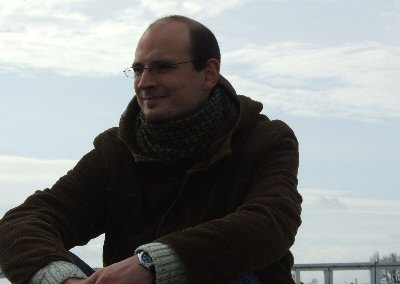
that's me...

that's me...
...just to give you a first impression of what I look like. I'll add some more pictures soon.
Showing posts with label M3. Show all posts

Sunday, March 16, 2008

On Friday we continued our discussion about Popper and his theories. Popper’s approach to alter the historical way of knowledge acquiring also implemented a change in the social hierarchy proposed by Plato (philosophers at the top of a pyramide). In Popper’s view democracy was not to elect a government but to have the possibility to get rid of a bad government. This could only work if the respective leaders subordinated their own interests to the interests of the society. The education of pupils therefore has to serve the aim of providing the possibility for the pupils to stay within the “democratic circle” discussed a few lessons ago. Hence we should train pupils in scientific working.

The concluding discussion about Popper's scheme of the human mind should again underline the differences between traditional learning and modern approaches. While traditional teaching methods often concentrate on learning the modern problem-solving approaches invclude parts of all three areas (learning, storing, practising). But it also warns against always using the same strategies because in this case nothing would be learned.

In the second part of the lesson we were asked to come up with problem-solving-exercises that we could use in our subjects. Since I had been taught about problem-solving teaching methods in chemistry lessons it was no problem to create a task according to Popper's approach of falsifying theories. I developed a lesson about acids and bases, the pH-value and indicators. I used a similar one during my school practical course last year. In my opinion it was a quite good example but I can also understand that my classmates were a bit overburdened and maybe bored. Well, nevermind...

Sunday, March 02, 2008

save the world...

On Friday we started off at 8.15 with our citizenship and globalisation course. Originally Birgitte wanted to sing some songs with us just for warming up our brains. Most of us were pretty tired and didn't really look forward to working ;-) .However we couldn't find any English songs in the songbook so we skipped the singing part and went directly to work. For homework we had prepared a short presentation about the influence of our educational systems on becoming citizens. That's what I wrote down during the presentations:We had discussed the introduction of citizenship as a subject in Denmark before, so in this respect we didn't learn anything new. But it was interesting to how the different educational systems try to compensate their "lack" of a subject citizenship. In all out countries we have aspects of citizenship included - more or less overtly expressed - in other subjects (hidden goals, cross curriculum,...).

The second part of the the lesson we spent discussing. We started with the challenges we consider to be some of the biggest today, but we soon found ourselves amid a discussion about the caricature argument, different worldviews, religious vs. democratic values and so on. During the discussion Birgitte showed us some of the caricatures that caused the crisis in 2006 which experiences a revival those days. Some of us had quite opposing opinions about these caricatures, about why they were made and about the reactions they caused. I learned that they were made because there had been increasing problems with islamic fundamentalists in Denmark. The caricatures were meant to make people aware of the problem.
Flemming Rose, Jyllands-Posten's culture editor, said about this On September 30, 2005:
"
The modern,
secular society is rejected by some Muslims. They demand a special position, insisting on special consideration of their own religious feelings. It is incompatible with contemporary democracy and freedom of speech, where you must be ready to put up with insults, mockery and ridicule. It is certainly not always attractive and nice to look at, and it does not mean that religious feelings should be made fun of at any price, but that is of minor importance in the present context. [...] we are on our way to a slippery slope where no-one can tell how the self-censorship will end. That is why Morgenavisen Jyllands-Posten has invited members of the Danish editorial cartoonists union to draw Muhammad as they see him. [...]"
A bit later (February 19, 2006) he also explained that
"The cartoonists treated Islam the same way they treat Christianity, Buddhism, Hinduism and other religions. And by treating Muslims in Denmark as equals they made a point: We are integrating you into the Danish tradition of satire because you are part of our society, not strangers. The cartoons are including, rather than excluding, Muslims."

Personally I know that these are caricatures and that they are supposed to show contents in a highly exaggerated way. But one the other hand I ask myself if it's the right way to draw a person with a bomb in his head and the Shahada (the Islamic creed) on top of it (I don't know for sure if it's really the shahada because I'm not that good in Arabic, but to me it looks very similar). In my opinion that is an insult to all Muslims and I can actually understand that it caused indignation within the Islamic world. But I'm certain that this again is not a reason to start riots and violence resulting in more than 100 deaths and setting fire to Danish Embassies and storming European buildings.

We talked for a long time about the different values within societies and if one societiy can assert a claim to superiority to others. Another important question was whether democratic values are more important than religious beliefs. I think not all of us were really interested in these topics but to me it was quite important to discuss these matters. In the end we didn't reach a consensus and we certainly didn't save the world that day but after all I found the lesson very informative and interesting (I think more than any other lesson before during the last weeks).

I arranged a small list of links you can visit when you are interested in the discussion. The first one is a link to the twelve caricatures published on September 30, 2005. The second one is a wikipedia article about the caricature argument (that's also where my quotes are taken from). The third one in an article about the shahada.

http://www.citybeat.de/news/2070231/die-12-mohammed-karikaturen.html
http://en.wikipedia.org/wiki/Jyllands-Posten_Muhammad_cartoons_controversy
http://en.wikipedia.org/wiki/Shahadah

Sunday, February 10, 2008

"Democracy for $500, please"...

"Give a water-tight definition for citizenship!"
I guess for a candidate in a quiz this question would be impossible to answer. There is not one single unchallenged definition for "citizenship". It is an essentially contested concept but what different approaches have in common is that citizenship is more than just knowing about rights and duties. It is also about identity and feelings of belonging.
But why is that important for us? I think that was the question most of us had in mind when we went to the citizenship and globalisation course on Friday. The answers to that questions were not easy to find. I will just try to summarize at least some of the attempts to find a solution:
During the last 25 years the EU had to face huge waves of immigrants coming to the European countries. This in combination with a decreasing knowledge about democracy among young people lead to a widespread discourse about the topic. In some countries this academic discourse resulted in the change of educational curricula or in the development of new school subjects. Central aims were in all cases to arouse an interest in the students to deal with the topic of citizenship. In the first place democratic values should be protected and no longer be seen as perpetually given. Democracy is a fragile concept and it is put to the test these days by migration, individualization and globalization. It implies not only a passive (signing a document, possessing a passport, ...) but also an active (raise one's voice, take part in society) role. As future teachers it will be our task to continue that discourse.