Monday afternoon we met with Torbjörn again for a rather theoretical lesson. We were presented the philosophical roots of Popper's way of thinking starting with Plato and his "cave" tale. The guiding question in traditional philosophy: "How can we reach the truth (or also Truth when refering to the one and only truth)?" was answered by Plato with the assumption that truth can't be found when looking at the world. One of Plato's students, Aristotle, devided truth into three parts:
1. episteme (logical truth (scientific truth))
2. techne (used knowledge (technology, art,...)
3. phonesis (wisdom to make good choices (behaviour))
With Christianity the traditional philosophy lost its importance due to God's absolute truth. Only with the renaissance, reformation and enlightenment the absolute truth of the church was again put to the question. Two different schools of philosophy developed out of this primordial soup: the French school (Descartes) going from theory to observation (deduction) on the one hand and the English school (Locke) going from observation to theory (induction). The latter was challenged by Hume who stated that for example not all swans are white.
Popper finally furnished a new approach. He answered the traditional guiding question with a denial. In his opinion we can't reach the truth, or at least we wouldn't know we are there. His new guiding question was then: "What mistakes do we make and how can we avoid them?" His idea of teaching deriving from this question focused on the pupil comming up with a theory and trying to falsify it. He stated that criticising theories is an important step in the education of innovative and democratic pupils. In this context it is necessary to mention that inductive and deductive teaching-learning-processes do not take part seperated from each other. Whenever the teaching is inductive (student-centred) the learning process is deductive (problem based learning). One the other hand, when the teaching is deductive (monologue) the learning is inductive (observation -> theorie).
The problem with Pooper's theorie is that he also talks about three different worlds:
world 1: everything you can touch (e.g. books, tables, pictures,...)
world 2: the world actual persons perseive it (personal impressions)
world 3: general knowledge of mankind (e.g. what's written in the books)
Pupils can only get access to world three when guided by teachers. This indicates one of the paradoxes of the Popperian philosophy. It is impossible to let the pupils come up with their own theories when they need guidance to world three at the same time. The solution then has to be a mixture of teaching-learning-practices.
that's me...
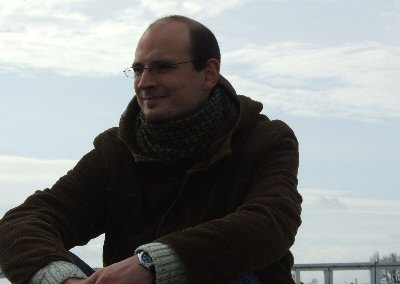
...just to give you a first impression of what I look like. I'll add some more pictures soon.
Thursday, March 13, 2008

Tuesday, March 04, 2008
European school traditions...
On Monday we were supposed to meet Tove Heidemann. But something was wrong in the schedule so we got an extra hour to get rid of our morning fatigue. Which was to be honest not the worst idea. But finally we started into our lecture about different European school traditions with learning about the European Commission's goal to indicate European core values and a common history and culture. On the other hand we learned about historical and geographical borderlines, e.g. the "limes" (lat.: borderline farest away from Rome) along the Rhine and the Danube, deviding Europe into a northern and a southern part. We came across differences in culture, society, religion, and so on. As these were more generalized assumptions we afterwards turned towards the rather local level, i.e. the schools in the different countries. Tove presented us the theory of Edgar Schein who seperated the organization of school culture into three levels:
Level 1: Artefacts (what you can observe): e.g. appearance, equipment, cantine, subjects, interaction, behaviour
Level 2: Exposed values (what you can explain): e.g. rationalities, reasons for organization, aims
Level 3: Basic assumptions (what you cannot observe / explain): e.g. interpretations of values and artefacts, main tasks, how is "learning" looked upon
After this rather theoretical part we made a short journey to France, Italy, Portugal, Spain and Belgium (encyclopedic approach), Great Britain (humanistic approach) and Germany, The Natherlands and Scandinavia (naturalistic approach). The data presented was taken from the book "Britain and a single market Europe" by Martin McLean but unfortunately almost 20 years old. Therefor it has to be critically questioned whether these data is still valid today or whether things have changed. The data was as follows:
encyclopedic: Uniformity (knowledge about as many issues as possible, centralized curriculum and tests), rationality (no emotions, logical way of thinking, France, science, history and philosophy), elitism (competition rather than cooperation, universities and grand ecoles)
humanistic: high moral standard (ideal of the gentleman, empathy, sense of duty, brotherhood), individualism (close contact between teachers and students, individual learning speed), specialisation (choice of 2-3 subjects to focus on at the age of 16)
naturalistic: community needs (streaming of pupils, every job has its function and own dignity, hard work, economical behaviour), imitating of parents' way of socialising (parents have much influence, learning by imitation, process as important as product, skills-oriented)
Many of those values and strategies may have disappeared or been altered over the years. Thus it's difficult to actually work with this data. But nevertheless it indicates that there have been differences between countries and their concepts of education. In how far these differences still exist could be an interesting topic to do research in.
A very controversial question came up towards the end of our meeting: there are schools for pupils with special needs in Denmark but no (or very few) schools for highly gifted pupils. What is the reason for that? Do not pupils with special talents or above average intelligence also deserve an adequate education? We again mentioned the "jante" law - which I personally think to be a questionable value after reading the ten rules - but is it a sufficient explanation to "suppress" talent? In my opinion talent should be advanced. Not to educate a superior elite of pupils but to help gifted pupils to use their talents to support and improve the society and to become socially capable citizens.
Level 1: Artefacts (what you can observe): e.g. appearance, equipment, cantine, subjects, interaction, behaviour
Level 2: Exposed values (what you can explain): e.g. rationalities, reasons for organization, aims
Level 3: Basic assumptions (what you cannot observe / explain): e.g. interpretations of values and artefacts, main tasks, how is "learning" looked upon
After this rather theoretical part we made a short journey to France, Italy, Portugal, Spain and Belgium (encyclopedic approach), Great Britain (humanistic approach) and Germany, The Natherlands and Scandinavia (naturalistic approach). The data presented was taken from the book "Britain and a single market Europe" by Martin McLean but unfortunately almost 20 years old. Therefor it has to be critically questioned whether these data is still valid today or whether things have changed. The data was as follows:
encyclopedic: Uniformity (knowledge about as many issues as possible, centralized curriculum and tests), rationality (no emotions, logical way of thinking, France, science, history and philosophy), elitism (competition rather than cooperation, universities and grand ecoles)
humanistic: high moral standard (ideal of the gentleman, empathy, sense of duty, brotherhood), individualism (close contact between teachers and students, individual learning speed), specialisation (choice of 2-3 subjects to focus on at the age of 16)
naturalistic: community needs (streaming of pupils, every job has its function and own dignity, hard work, economical behaviour), imitating of parents' way of socialising (parents have much influence, learning by imitation, process as important as product, skills-oriented)
Many of those values and strategies may have disappeared or been altered over the years. Thus it's difficult to actually work with this data. But nevertheless it indicates that there have been differences between countries and their concepts of education. In how far these differences still exist could be an interesting topic to do research in.
A very controversial question came up towards the end of our meeting: there are schools for pupils with special needs in Denmark but no (or very few) schools for highly gifted pupils. What is the reason for that? Do not pupils with special talents or above average intelligence also deserve an adequate education? We again mentioned the "jante" law - which I personally think to be a questionable value after reading the ten rules - but is it a sufficient explanation to "suppress" talent? In my opinion talent should be advanced. Not to educate a superior elite of pupils but to help gifted pupils to use their talents to support and improve the society and to become socially capable citizens.
Sunday, March 02, 2008
save the world...
On Friday we started off at 8.15 with our citizenship and globalisation course. Originally Birgitte wanted to sing some songs with us just for warming up our brains. Most of us were pretty tired and didn't really look forward to working ;-) .However we couldn't find any English songs in the songbook so we skipped the singing part and went directly to work. For homework we had prepared a short presentation about the influence of our educational systems on becoming citizens. That's what I wrote down during the presentations: We had discussed the introduction of citizenship as a subject in Denmark before, so in this respect we didn't learn anything new. But it was interesting to how the different educational systems try to compensate their "lack" of a subject citizenship. In all out countries we have aspects of citizenship included - more or less overtly expressed - in other subjects (hidden goals, cross curriculum,...).
The second part of the the lesson we spent discussing. We started with the challenges we consider to be some of the biggest today, but we soon found ourselves amid a discussion about the caricature argument, different worldviews, religious vs. democratic values and so on. During the discussion Birgitte showed us some of the caricatures that caused the crisis in 2006 which experiences a revival those days. Some of us had quite opposing opinions about these caricatures, about why they were made and about the reactions they caused. I learned that they were made because there had been increasing problems with islamic fundamentalists in Denmark. The caricatures were meant to make people aware of the problem. Flemming Rose, Jyllands-Posten's culture editor, said about this On September 30, 2005:
"The modern, secular society is rejected by some Muslims. They demand a special position, insisting on special consideration of their own religious feelings. It is incompatible with contemporary democracy and freedom of speech, where you must be ready to put up with insults, mockery and ridicule. It is certainly not always attractive and nice to look at, and it does not mean that religious feelings should be made fun of at any price, but that is of minor importance in the present context. [...] we are on our way to a slippery slope where no-one can tell how the self-censorship will end. That is why Morgenavisen Jyllands-Posten has invited members of the Danish editorial cartoonists union to draw Muhammad as they see him. [...]"
A bit later (February 19, 2006) he also explained that
"The cartoonists treated Islam the same way they treat Christianity, Buddhism, Hinduism and other religions. And by treating Muslims in Denmark as equals they made a point: We are integrating you into the Danish tradition of satire because you are part of our society, not strangers. The cartoons are including, rather than excluding, Muslims."
Personally I know that these are caricatures and that they are supposed to show contents in a highly exaggerated way. But one the other hand I ask myself if it's the right way to draw a person with a bomb in his head and the Shahada (the Islamic creed) on top of it (I don't know for sure if it's really the shahada because I'm not that good in Arabic, but to me it looks very similar). In my opinion that is an insult to all Muslims and I can actually understand that it caused indignation within the Islamic world. But I'm certain that this again is not a reason to start riots and violence resulting in more than 100 deaths and setting fire to Danish Embassies and storming European buildings.
We talked for a long time about the different values within societies and if one societiy can assert a claim to superiority to others. Another important question was whether democratic values are more important than religious beliefs. I think not all of us were really interested in these topics but to me it was quite important to discuss these matters. In the end we didn't reach a consensus and we certainly didn't save the world that day but after all I found the lesson very informative and interesting (I think more than any other lesson before during the last weeks).
I arranged a small list of links you can visit when you are interested in the discussion. The first one is a link to the twelve caricatures published on September 30, 2005. The second one is a wikipedia article about the caricature argument (that's also where my quotes are taken from). The third one in an article about the shahada.
http://www.citybeat.de/news/2070231/die-12-mohammed-karikaturen.html
http://en.wikipedia.org/wiki/Jyllands-Posten_Muhammad_cartoons_controversy
http://en.wikipedia.org/wiki/Shahadah
 We had discussed the introduction of citizenship as a subject in Denmark before, so in this respect we didn't learn anything new. But it was interesting to how the different educational systems try to compensate their "lack" of a subject citizenship. In all out countries we have aspects of citizenship included - more or less overtly expressed - in other subjects (hidden goals, cross curriculum,...).
The second part of the the lesson we spent discussing. We started with the challenges we consider to be some of the biggest today, but we soon found ourselves amid a discussion about the caricature argument, different worldviews, religious vs. democratic values and so on. During the discussion Birgitte showed us some of the caricatures that caused the crisis in 2006 which experiences a revival those days. Some of us had quite opposing opinions about these caricatures, about why they were made and about the reactions they caused. I learned that they were made because there had been increasing problems with islamic fundamentalists in Denmark. The caricatures were meant to make people aware of the problem. Flemming Rose, Jyllands-Posten's culture editor, said about this On September 30, 2005:
"The modern, secular society is rejected by some Muslims. They demand a special position, insisting on special consideration of their own religious feelings. It is incompatible with contemporary democracy and freedom of speech, where you must be ready to put up with insults, mockery and ridicule. It is certainly not always attractive and nice to look at, and it does not mean that religious feelings should be made fun of at any price, but that is of minor importance in the present context. [...] we are on our way to a slippery slope where no-one can tell how the self-censorship will end. That is why Morgenavisen Jyllands-Posten has invited members of the Danish editorial cartoonists union to draw Muhammad as they see him. [...]"
A bit later (February 19, 2006) he also explained that
"The cartoonists treated Islam the same way they treat Christianity, Buddhism, Hinduism and other religions. And by treating Muslims in Denmark as equals they made a point: We are integrating you into the Danish tradition of satire because you are part of our society, not strangers. The cartoons are including, rather than excluding, Muslims."
Personally I know that these are caricatures and that they are supposed to show contents in a highly exaggerated way. But one the other hand I ask myself if it's the right way to draw a person with a bomb in his head and the Shahada (the Islamic creed) on top of it (I don't know for sure if it's really the shahada because I'm not that good in Arabic, but to me it looks very similar). In my opinion that is an insult to all Muslims and I can actually understand that it caused indignation within the Islamic world. But I'm certain that this again is not a reason to start riots and violence resulting in more than 100 deaths and setting fire to Danish Embassies and storming European buildings.
We talked for a long time about the different values within societies and if one societiy can assert a claim to superiority to others. Another important question was whether democratic values are more important than religious beliefs. I think not all of us were really interested in these topics but to me it was quite important to discuss these matters. In the end we didn't reach a consensus and we certainly didn't save the world that day but after all I found the lesson very informative and interesting (I think more than any other lesson before during the last weeks).
I arranged a small list of links you can visit when you are interested in the discussion. The first one is a link to the twelve caricatures published on September 30, 2005. The second one is a wikipedia article about the caricature argument (that's also where my quotes are taken from). The third one in an article about the shahada.
http://www.citybeat.de/news/2070231/die-12-mohammed-karikaturen.html
http://en.wikipedia.org/wiki/Jyllands-Posten_Muhammad_cartoons_controversy
http://en.wikipedia.org/wiki/Shahadah
Saturday, March 01, 2008
digging deeper...
On Thursday we met Torbjørn again and evaluated about our experiences and observations at the Hoptrup efterskole on Monday. We all had recognized the freedom of the pupils, the friendly relationship between teachers and pupils and the homelike atmosphere in the school. Afterwards Torbjørn introduced us to the theoretical approach towards planing a curriculum by Alistair Ross. Ross distinguishes between three different ways of planing a curriculum:
1. classical humanist academic way (content and subjects in focus, teacher as instructor)
2. utilitalian way (objectives in focus, teacher as guide)
3. progressive way (process in focus, teacher as equal partner)
How intensively these ways are followed or if there are mixtures in between the ways differs from country to country. Our task was it then to make up tree diagrams about our own educational systems and the Danish (according to our observations and what we've learned so far) one. These are the tree diagrams I came up with:

We presented our results to each other and concluded that there are approaches in all countries to work more learner-centred. We also talked about the political dimensions of this paradigm and the relationships between the three ways.
 The second part of the lesson was about citizenship again. Torbjørn presented the book "The open society and its enenmies" by Karl Popper to us. Popper deals in his book indirectly with the threats to society like nationalism and communism. He uses the works of Plato about collectivism and altruism on the one and individualism and egoism on the other hand. But unlike Plato he allows cross-connections between these expressions and denotes them with political attributes.
 In a second step we added extreme formations of these political/social ideas which are located somehow outside the society.
For me it was interesting to hear that even Plato dealed with the problem of threats to a society (so it's not a modern phenomenon at all) and that political attributes like "right" or "left" just refer to the historical distribution of the members of parliament seen from the speaker's perspective.
 At the end we tried to apply Poppers diagram to the different ways of planing a curriculum. Here the circle closed.
1. classical humanist academic way (content and subjects in focus, teacher as instructor)
2. utilitalian way (objectives in focus, teacher as guide)
3. progressive way (process in focus, teacher as equal partner)
How intensively these ways are followed or if there are mixtures in between the ways differs from country to country. Our task was it then to make up tree diagrams about our own educational systems and the Danish (according to our observations and what we've learned so far) one. These are the tree diagrams I came up with:


We presented our results to each other and concluded that there are approaches in all countries to work more learner-centred. We also talked about the political dimensions of this paradigm and the relationships between the three ways.
 The second part of the lesson was about citizenship again. Torbjørn presented the book "The open society and its enenmies" by Karl Popper to us. Popper deals in his book indirectly with the threats to society like nationalism and communism. He uses the works of Plato about collectivism and altruism on the one and individualism and egoism on the other hand. But unlike Plato he allows cross-connections between these expressions and denotes them with political attributes.
 In a second step we added extreme formations of these political/social ideas which are located somehow outside the society.
For me it was interesting to hear that even Plato dealed with the problem of threats to a society (so it's not a modern phenomenon at all) and that political attributes like "right" or "left" just refer to the historical distribution of the members of parliament seen from the speaker's perspective.
 At the end we tried to apply Poppers diagram to the different ways of planing a curriculum. Here the circle closed.
"You're so meeeeeaaaaaaan..."
Our music class on Wednesday started with lecture by Flemming Rasmussen about the influence of art and aesthetics on learning processes. It was a bit difficult for me to really get the point of the lecture. At the beginning I thought that he was of the opinion that aesthetics and pupils freedom to act, perform and produce art are more important than the actual learning (mathematics, vocabulary,...). It took some time and some more explanations for me to understand that aesthetics should only work as transport media for the content. Well, now I have an idea about that and I must say that it could possibly be a good way of teaching. On the other hand we already include games, role plays, presentations in our lessons which can - in my opinion - be seen as aesthetic learning. But maybe we should strengthen this part even more. I will have to think about it a bit more, but it's another idea/impression I will probably check out when I do my next practice in Germany.
In the second part of our lesson we presented the performances and posters we had made in connection with a piece of pipe music Else Marie had given us at the end of our meeting. We came up with three different stories and three different interpretations of the music. What they had in common was some kind of argument. Kate and Sylvie
 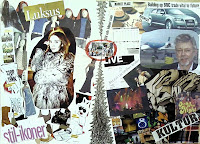 performed the argument of a wife and a husband. The husband had forgotten their ten year's anniversary and she was upset and crestfallen. Tim, Manu and Charlotte presented a princess (good job, Tim!) asking her father for permission to marry the prince of her heart, but he wanted her to marry the one he had chosen. Last but not least Iva and me performed our shopping scene of a couple. You can watch the movie if you like. In case that the dialogue is too fast or you don't understand everything look at Iva's blog, she has the text in written form.
After our presentations we repeated the songs we learned three weeks ago. Maybe we can teach some of them to the international students coming to Haderslev in week 11. Sing with me: "Hand and shoulders, knees and toes..."
In the second part of our lesson we presented the performances and
 posters we had made in connection with a piece of pipe music Else Marie had given us at the end of our meeting. We came up with three different stories and three different interpretations of the music. What they had in common was some kind of argument. Kate and Sylvie
  performed the argument of a wife and a husband. The husband had forgotten their ten year's anniversary and she was upset and crestfallen. Tim, Manu and Charlotte presented a princess (good job, Tim!) asking her father for permission to marry the prince of her heart, but he wanted her to marry the one he had chosen. Last but not least Iva and me performed our shopping scene of a couple. You can watch the movie if you like. In case that the dialogue is too fast or you don't understand everything look at Iva's blog, she has the text in written form.
discovering the child in you (part two)...
Tuesday and Friday was Danish time again. We tried out more playful ways of learning a language. On Tuesday we trained our vocabulary knowledge with cards that contained words on the left side and images on the right side. We now had to connect the words with the matching images  with a red twine and could control ourselves on the basis of painted lines on the back of the cards. The second task was some kind of memory game with images on the one and words on the other side of the cards. That was great fun! And I learned some new expressions and words.
On Friday we cut out personal pronouns and subjects, verbs and adverbial complements from a sheet of paper. Afterwards we composed different sentences. And we had an argument about who is "jumping on the moon" ;-)
 with a red twine and could control ourselves on the basis of painted lines on the back of the cards. The second task was some kind of memory game with images on the one and words on the other side of the cards. That was great fun! And I learned some new expressions and words.
On Friday we cut out personal pronouns and subjects, verbs and adverbial complements from a sheet of paper. Afterwards we composed different sentences. And we had an argument about who is "jumping on the moon" ;-)
discovering the (creative) child in you...
 On Monday afternoon we visited the Hoptrup efterskole, a private boarding school in a village near Haderslev. The school accommodates round about 80 pupils aged 15 and 16. They usually stay there for one year in the 9th or 10th grade. The main focus is on theatre, dance and music. These are also the topics the
  pupils can chose from for their afternoon classes.
We had a nice guided tour by two of the pupils and I think all of us liked the atmosphere and the possibilities the pupils have to arrange their free time.
After the tour we joined the English class. The lesson started with a role play in which the pupils should act out various situations in pairs(arguments, shopping tours etc.) they had made up before. Tim and me joined the "acting crew" and it was a lot of fun, especially because most pupils were not shy at all to perform in front of the class (well, it' s a school with an aesthetic profile, so...). Then the class was split up into three groups and we discussed with them. They had many questions, for example why we wanted to become teachers,
 what our impressions of Denmark were and so on. It was a nice discussion because they were not afraid to speak and seemed to be very interested. The last part of the lesson was a summary of the previous teaching unit. The topic had been South Africa and the pupils were asked to design a mindmap and present their results to the whole class. It was again quite impressive to see the pupils use the English language naturally.
Well, the next part of our observation day contained the dance lessons. I was a bit afraid that we would
 also have to participate in these lessons (well, not exactly "have to", but you know, when you are asked politely...) but we didn't have to, phew! The first hour we joined the class more oriented towards techniques and the accurate performance of movements. The second hour we spent with the more creative class. The pupils had to listen to music and make up their own performances according to more or less strict orders. We left the school at five in the afternoon and went back to Haderslev. It was a very nice and impressive afternoon and I could easily imagine to do my practice at that school, but it's still too soon to make a decision about this because some more school visits are to come soon.
Wednesday, February 27, 2008
Are we competent enough...
The guiding question: "What is intercultural competence?" lead through our Monday's course with Jette. As a preparation we had to read an article about the teacher's intercultural competence. It was approximately as hard to understand as our homework for the citizenship course since it was a rather theoretical approach. Working with the text in a more practical way during the course helped a lot to understand the ideas expressed in the text. Defining intercultural competence as gaining knowledge and abilities concerning your own culture and intercultural learning as learning from people from different cultural backgrounds inavitably lead to the question: "What is culture?" A possible answer to that question was furnished by the onion diagram by Geert Hofstede. Symbols include sights, royal families, buildings, landscapes, flags,... Heroes are persons (dead or alive) who are popular in their own country and who become also known in other countries (e.g. sportsmen/women, politicians, actors, singers, models,...). Rituals could be for example greetings, the celebration of public holidays,... Values finally are freedom, equality, emanzipation,... The onion diagramme shows how the culture of a society
  is devided into subcategories. The importance and influence of this culture on individuals Hofstede tries to make clear in his mental programme. He distinguishes between inherited vs. learned on the one and universal vs. specific areas on the other hand. At the end of the lesson we returned to the text and had a closer look at the three dimensions of the teacher's intercultural competence:
1. cognitive: knowledge about the world, education, media
2. behaviourial: body language, clothing, rituals, understanding
3. affective: emotional base, self-respect, empathy, curiosity
 and abilities concerning your own culture and intercultural learning as learning from people from different cultural backgrounds inavitably lead to the question: "What is culture?" A possible answer to that question was furnished by the onion diagram by Geert Hofstede. Symbols include sights, royal families, buildings, landscapes, flags,... Heroes are persons (dead or alive) who are popular in their own country and who become also known in other countries (e.g. sportsmen/women, politicians, actors, singers, models,...). Rituals could be for example greetings, the celebration of public holidays,... Values finally are freedom, equality, emanzipation,... The onion diagramme shows how the culture of a society
  is devided into subcategories. The importance and influence of this culture on individuals Hofstede tries to make clear in his mental programme. He distinguishes between inherited vs. learned on the one and universal vs. specific areas on the other hand. At the end of the lesson we returned to the text and had a closer look at the three dimensions of the teacher's intercultural competence:
1. cognitive: knowledge about the world, education, media
2. behaviourial: body language, clothing, rituals, understanding
3. affective: emotional base, self-respect, empathy, curiosity
Too many cooks spoil the broth???
 On Wednesday we met at noon with the cooking class to prepare an international buffet. The variety of different dishes ranged amongst others from czech potato soup, pancakes and fruit dumplings over German-Danish hot dogs and Belgian mashed potatoes with sausages, chocolate mousse and waffles to Sushi and smorebrod compositions. The teamwork within the multicultural groups went well and even the cleaning and washing up turned out to be unproblematic. It was quite a challenge to have that many people in the kitchen but in the and one had to say that "many hands make light work".
Monday, February 25, 2008
The portrait of the artist...
On Wednesday it was art time. We met with Dorthe Rizzi in the art room and for warming up we had some coffee and tea. Then we went to business:  We should produce drawings of each other in only two minutes (so we actually hadn't time to think about what we were doing). Most of the drawings didn't look like the persons pictured but we had some fun and lost at least a bit of our fears for the pen and paper. Afterwards we were told to draw ourselves, sitting in front of a mirror. This task wasn't designed to take more than five minutes but I somehow developed some kind of connection to my drawing that made me keep on drawing (quite strange situation since I hadn't drawn for years,
 but I just couldn't stop...). I was quite happy that Dorthe didn't have something to object about my wish to continue. Regrettably, I missed the other tasks that my classmates had to work on (painting on mirrors, printing,...) but the picture I produced made up for that. It doesn't really look like me completely but you can maybe find some similarities or at least attest to the fact that it shows a human person...
 We should produce drawings of each other in only two minutes (so we actually hadn't time to think about what we were doing). Most of the drawings didn't look like the persons pictured but we had some fun and lost at least a bit of our fears for the pen and paper. Afterwards we were told to draw ourselves, sitting in front of a mirror. This task wasn't designed to take more than five minutes but I somehow developed some kind of connection to my drawing that made me keep on drawing (quite strange situation since I hadn't drawn for years,
 but I just couldn't stop...). I was quite happy that Dorthe didn't have something to object about my wish to continue. Regrettably, I missed the other tasks that my classmates had to work on (painting on mirrors, printing,...) but the picture I produced made up for that. It doesn't really look like me completely but you can maybe find some similarities or at least attest to the fact that it shows a human person...
Subscribe to:
Posts (Atom)